
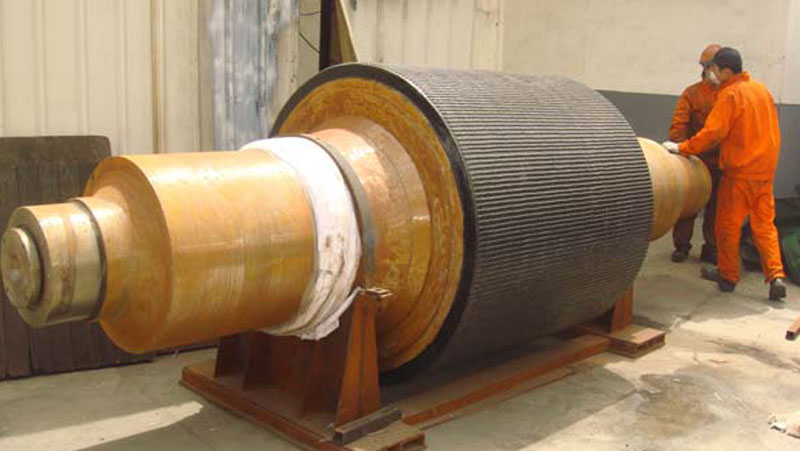
Custom roller press roller shell ready for installation. AGICO manufactures complete rollers and replaceable shells according to approved drawings.
CUSTOM WEAR COMPONENTS FOR CEMENT GRINDING
Roller Press Roller and Roller Shell for Cement Grinding
A roller press roller shell is the replaceable wear component on the working roller. It is the part that directly contacts raw meal, clinker, slag, or other brittle materials. Its quality affects grinding efficiency, energy consumption, and production cost.
AGICO supplies custom roller shells based on approved drawings, measurable samples, and confirmed operating data. Material, hardness, dimensions, and acceptance requirements are confirmed for each project individually.
REQUEST A ROLLER SHELL REVIEWHow a Roller Press Roller Works
A roller press uses two counter-rotating rollers to compress material. One roller is fixed. The other moves against hydraulic pressure. Material enters the gap between them and is crushed under high force.
The roller shell does three things:
- Grips the material and pulls it into the gap
- Transfers pressure across the roller width
- Protects the roller core from direct wear

Two counter-rotating rollers draw material into the grinding gap and compress it under high force.
SURFACE SYSTEM SELECTION
Roller Shell Surface Types – Which One Fits Your Mill?

Hardfaced Surface
Welded wear-resistant layer applied to the roller surface. Can be rebuilt multiple times.
Best For: Cement raw meal and clinker grinding where repairability is valued.

Studded Surface
Hard metal inserts (studs) installed in the roller surface. Material between studs forms a protective layer.
Best For: Slag grinding and highly abrasive materials.
Composite Shell
Replaceable shell design that protects the roller core. Core can be reused.
Best For: Large rollers where full replacement is expensive and the core is in good condition.
SUPPLY SCOPE
What AGICO Can Supply – Four Options
Once you know which surface type you need, choose the right supply option:
| What You Get | What It Means | When to Choose |
|---|---|---|
| Complete Roller | Full assembly – roller body, shaft connection, and finished wear surface. Ready to install. | Your existing roller is damaged beyond repair, or you need a complete spare unit. |
| Roller Shell (Bandage) | Replaceable wear layer only. Fits onto your existing roller core. | Your roller core is still in good condition, but the wear surface is worn out. |
| Roller Shaft | Structural shaft that transmits power to the roller. | The shaft is worn, cracked, or damaged. Requires separate quotation. |
| Surface Repair | Rebuilds the worn profile by welding (hardfacing) or replacing studs. | The roller body is sound, but the surface profile is worn and needs restoration. |

Complete roller

Replaceable roller shell

Roller shaft

Surface repair
MATERIAL, PROCESS & QUALITY
Why Choose AGICO?
High-Strength Materials – Built to Last
Depending on the roller design, surface system, and operating conditions, AGICO can supply 42CrMo or 35CrMo forged alloy-steel components, as well as bimetal composite roller shells. The final material and manufacturing route are confirmed against the approved drawing and service requirements.
Bimetal Centrifugal Composite Casting – Up to 3× Longer Life
For large roller shells, AGICO uses bimetal centrifugal composite casting technology. The outer layer is high-alloy steel (HRC 60–64) for wear resistance. The inner layer is high-toughness steel (HRC 30–35) for impact resistance. The two layers are metallurgically bonded. This gives you up to 3 times the service life of ordinary roller shells.
Precision Machining – Proper Fit, Smooth Operation
AGICO uses large CNC machine tools for precision machining. Dimensional accuracy reaches ±0.05mm and surface roughness reaches Ra≤0.8μm. This ensures proper fit with the roller core and smooth operation.
Surface Repair Available – Extend the Life of Your Roller
AGICO offers hardfacing repair services. A new roller shell can be repaired 3–5 times before it must be scrapped. This is much cheaper than buying a new roller.
100% NDT Tested – No Hidden Defects
Every roller shell undergoes non-destructive testing (UT, MT, PT) before leaving the factory. This ensures every roller shell is free from cracks, porosity, and inclusions.
Custom Manufacturing – Made for Your Mill
AGICO can manufacture roller shells according to customer drawings or original specifications. We can also reverse-engineer worn roller shells if drawings are not available.
Technical Specifications
- Material Options: 42CrMo, 35CrMo, High Chrome Alloy, Tungsten Carbide Composite
- Surface Hardness: HRC 60–64 (bimetal composite)
- Core Hardness: HRC 30–35 (bimetal composite)
- Surface Types: Hardfacing, Studded, Composite Shell
- Dimensional Accuracy: ±0.05mm
- Surface Roughness: Ra≤0.8μm
- Hardfacing Repairs: 3–5 times before scrapping
- Service Life: Up to 3× longer than ordinary shells (bimetal composite)
- Compatibility: All major roller press brands
- Customization: Yes, according to customer drawings or original specifications

AGICO roller shells are engineered for raw meal, clinker, slag, and coal grinding applications in cement plants worldwide.
Common Wear Issues – What to Check
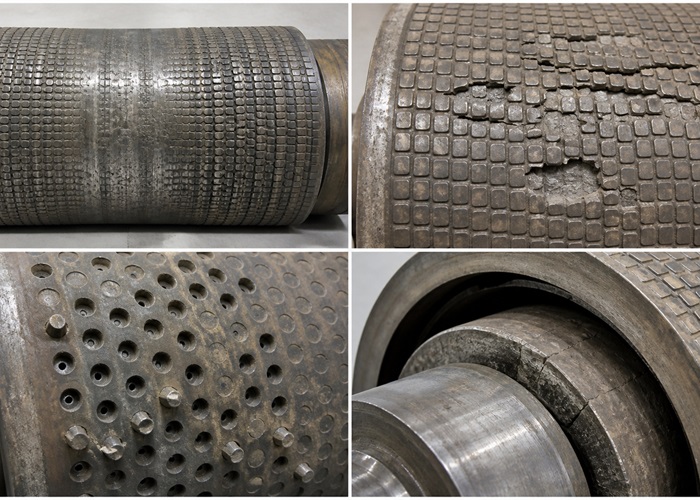
Common wear issues – uneven profile, cracked hardfacing, and missing studs. Regular inspection helps plan timely repair or replacement.
| What You See | What to Check | Recommended Action |
|---|---|---|
| Uneven or hollow wear across the face | Feed distribution, pressure balance, alignment | Adjust feed or alignment. Replace shell if worn beyond limit. |
| Cracks or spalling in the weld layer | Welding history, base metal condition, overload events | Clean and inspect. Repair if base metal is sound. |
| Loose, broken, or missing studs | Hole condition, fixing method, operating force | Replace studs if the system allows. |
| High vibration or overheating | Bearings, shaft, coupling, lubrication | Check the whole drive train. Not always a roller issue. |
BUYER QUESTIONS
Frequently Asked Questions (FAQ)
Q1: Is a roller shell the same as a complete roller?
A: No. A roller shell is the replaceable wear layer. A complete roller includes the core, shaft, and wear surface – everything needed to install.
Q2: Can AGICO make a roller shell without the original drawing?
A: Yes, we can reverse-engineer from a good sample. We need the sample, mating dimensions, and operating data. A badly worn shell alone may not give us enough information.
Q3: Hardfacing or studs – which is better?
A: Neither is better in all cases. Hardfacing is repairable and cost-effective for standard applications. Studs last longer in high-wear applications like slag grinding. We recommend based on your specific conditions.
Q4: Can I reuse my old roller core with a new shell?
A: Yes, if the core passes inspection. We check dimensions and perform NDT. Visual inspection alone is not enough.
Q5: How long will an AGICO roller shell last?
A: We do not promise a fixed number because actual life depends on your feed and operating conditions. What we promise is that we select the right material and surface for your specific conditions. For large shells, our bimetal composite casting gives up to 3 times the life of ordinary shells.
Q6: Do you provide on-site surface repair?
A: Yes. This is a separate service. We evaluate location, roller condition, and site access. Contact us for details.
PREPARE AN ACCURATE QUOTATION
Ready to Get a Quote?
What to Send for a Quote
To help us provide an accurate quotation quickly, please prepare the following:
- Roller press model and part position
- Drawing or sample (if available)
- Current surface type and wear photos
- Feed material and operating data
- Quantity needed and planned shutdown date
Send Us Your Information
Email your drawing and photos to AGICO. Our team will review your requirements and respond with a detailed quotation.
SEND YOUR DRAWING AND WEAR PHOTOS FOR A QUOTE